


The Birth of a Rivalry
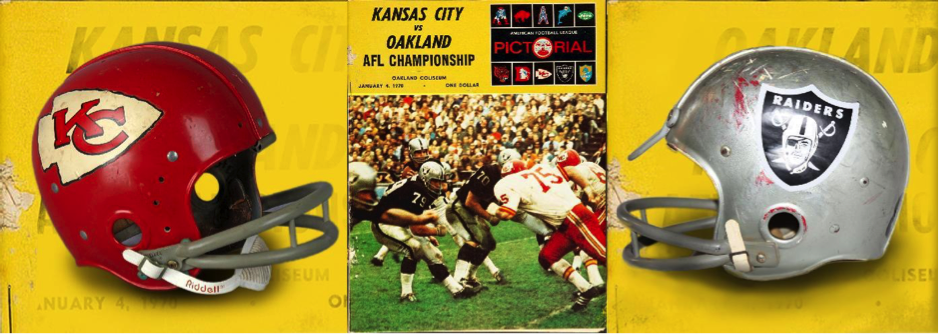
The Kansas City Chiefs and the Oakland Raiders don’t like each other much. But how did one of the NFL’s bitterest rivalries begin? It can all be traced back to the early days of the AFL…
“We knew we had to go through Oakland to win the championship, and they knew they had to go through Kansas City… That made it a very bitter rivalry.”
–Hank Stram, former Kansas City Chiefs head coach
The wonder years
1966: The Kansas City Chiefs upset the two-time, defending champions, the Buffalo Bills, to win their first AFL title. They would go on to lose the first-ever Super Bowl (played against the NFL champions) to Vince Lombardi’s Green Bay Packers.
1967: The Oakland Raiders win their first AFL championship. They would also go on to lose in their first Super Bowl appearance… to none other than Lombardi’s Packers.
1968: A tie in the Western division standings necessitated a ‘wild card’-style play-off game before the AFL Championship showdown – between the Chiefs and the Raiders. The Raiders won and secured a chance to face the New York Jets and defend their AFL title. They would lose their crown to the Jets, who would rub salt into Oakland’s wounds by recording the AFL’s first Super Bowl victory.
1969: The AFL introduces inter-divisional play-offs for the first time in its ten-year existence. The Chiefs and the Raiders both qualify. The Chiefs take down the defending Super Bowl champions, the Jets, in a closely contested 13-6 win. The Raiders blow out the Houston Oilers 56-7. The stage is set for an AFL Championship game between two great rivals…
“Those were my favourite games… I always likened them to a heavyweight fight. You knew you were going to get beat up, but it was fun. We needed the Chiefs. We wouldn’t have been as good without them.”
–Ben Davidson, former Oakland Raiders defensive end
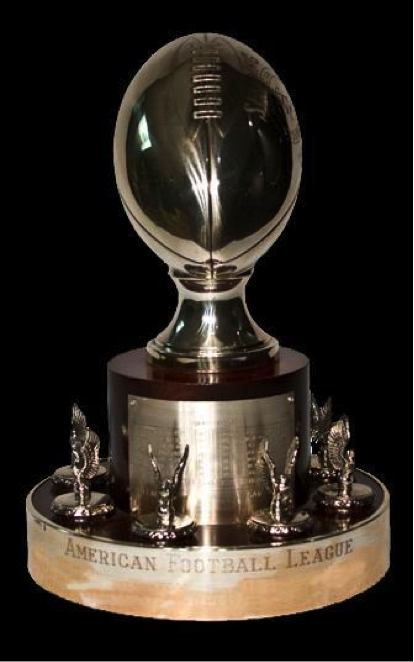 The design of the Lombardi Trophy appears to have been inspired by the AFL Championship Trophy.
The AFL Championship game had grown in significance by the time the Raiders and the Chiefs had the chance to go toe-to-toe in 1969. The winner would earn the right to play in the Super Bowl and lay claim to being the best professional team in America. Even more importantly, it was a chance to banish the long-standing feeling of inferiority that had plagued AFL franchises. The NFL was the better league and had the better teams. The AFL couldn’t compete. They had heard it for years. The AFL’s Jets had upset the NFL’s Baltimore Colts and won the previous season’s Super Bowl; nevertheless, many sports writers and fans thought it was a fluke and continued to believe that the NFL was superior to the AFL. Both the Chiefs and the Raiders were out to dispel the myth.
The road to the title game
It appeared that the Chiefs, led by head coach Hank Stram and star quarterback Len Dawson, were jinxed throughout the 1969 season. In just the second game of the regular season, Dawson suffered a knee injury that kept him from playing the next six games. Despite their troubles, the Chiefs managed to finish in second place behind the Raiders in the AFL’s Western division, but only after suffering a tough 10-6 loss to Oakland in the final game of the season, which had followed another closely contested defeat, 27-24, to their rivals only three weeks earlier. After that game, many sports writers and fans rounded on Dawson and the team for poor play-calling and relying too heavily on the run.
Nevertheless, the Chiefs still managed to clinch a play-off spot. Wanting to set itself up more like the NFL right before the merger, the AFL expanded the play-offs for the 1969 season by having the second-place teams face the first-place teams from the other division (Western champion vs Eastern runner-up, and vice versa). As a result of the new play-off format, the Chiefs were ridiculed for entering the play-offs through a “back door” as the runner-up in the Western division. But Dawson silenced the critics in the divisional play-offs by leading Kansas City to a 13-6 victory in New York over the Jets, the defending champions.
Still, many people felt that Dawson’s level of play in the AFL was not comparable to that in the NFL. Dawson himself had spent five seasons in the NFL as a backup before going to the AFL and becoming one of its top quarterbacks. “The AFL saved my career,” Dawson said. In his eight AFL seasons, he had thrown more touchdown passes (182) than any other professional football quarterback during that time. But because many continued to view the AFL as being inferior to the NFL, his records were not considered significant. Dawson’s first chance to prove himself against an NFL team ended in failure, with his Chiefs losing 35-10 in Super Bowl I, reinforcing the notion that his success was only due to playing in the “lesser league”. With critics’ comments still ringing in their ears, and the sting of two consecutive defeats to their arch-rivals fresh in the memory, Dawson and the Chiefs were understandably fired up. They felt more than ready to face the Raiders in the biggest and most heavily anticipated AFL Championship game to date.
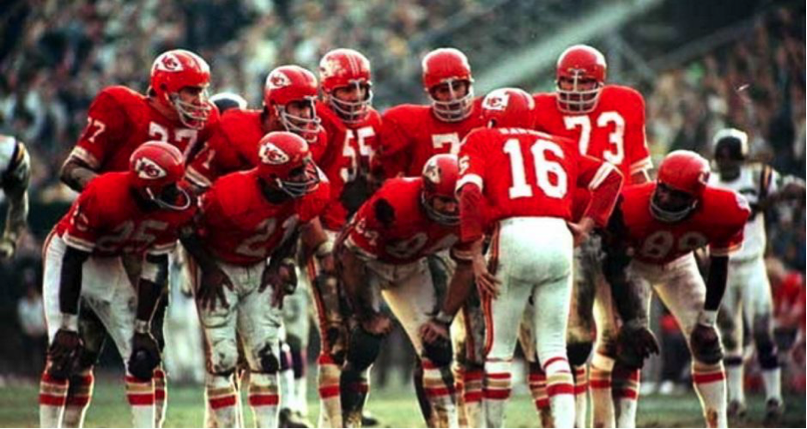 Number 16, Dawson calls the shots for the 1969 Chiefs.
The Raiders’ season took a different trajectory to that of the Chiefs, but the end result was the same – a berth in the AFL Championship game. The season marked the head-coaching debut of Hall of Famer John Madden, who had been promoted from his position as Raiders linebackers coach. He became professional football’s youngest head coach at the time, aged 32. Madden would go on to lead the Raiders to seven division titles, seven AFL/AFC Championship games and a Super Bowl triumph before leaving in 1978. He would post a 112-39-7 regular-season record over this span and remains the coach with the most wins in Raiders history. In his first season, Raiders fans certainly got a taste of the success to come. His inaugural campaign saw the team attempt to somehow improve on its 12-2 record from 1968 and continue its dominance of the Western division. The Raiders did just that as they stormed to a 12-1-1 record in 1969. Marshalled by their All-Star quarterback, Daryle ‘The Mad Bomber’ Lamonica, Oakland led the league in wins for a third consecutive season and, in doing so, posted a staggering 37-4-1 record over their final three years of AFL play. Having dealt with the rival Chiefs twice in the regular season and topped their division, the Raiders were primed for another play-off run.
The last game
Although the 12-1-1 Raiders were heavily favoured that afternoon after their vicious 56-7 inter-divisional play-off win over the Oilers, Kansas City had a respectable 11-3 record on the year and had twice bested the Super Bowl champions, the Jets. The fact that the two teams had played each other twice already was not lost on Stram; he had begun planning for this day before the regular season had even ended. In their last match-up, Kansas City’s dapper, innovative coach had the Chiefs run at the Raiders, allowing his quarterback, the 13-year veteran Dawson, to throw only six passes. Dawson still had fragile knees, but Stram also figured that, if he could beat Oakland on the ground, he wouldn’t have to reveal any of the new passing wrinkles that he hoped to use in the championship play-offs.
Borrowing a tactic from Lombardi and the Packers, Stram took his team to Santa Barbara for the week before Sunday’s game. The warmer weather allowed Dawson to sharpen his long passing game – frozen for a month in the snow and ice of Kansas City – and also permitted the Chiefs’ fleet receivers Otis Taylor, Frank Pitts and Gloster Richardson to add some frills to their moves. Oakland’s rookie coach, Madden, also added a few plays to his book. Armed cops kept close guard on the Oakland Coliseum throughout the week, and even shooed away the troops of Commissioner Pete Rozelle when the team was working out. On the eve of the game, Madden aped Cleveland Browns coach Paul Brown and sent his players to the movies before bed-check at an undisclosed motel.
As prolific Raiders quarterback and AFL Player of the Year Lamonica strode on to the field, he surveyed the scene: 11 Kansas City Chiefs stood before him and his goal – a Super Bowl berth. He had dissected the Oilers defense in a 56-7 mauling the week before, throwing no fewer than six touchdown passes, and anticipated doing the same again on this day. The game marked the AFL’s swan song before the impending merger with the NFL; it represented a chance for Lamonica to cement his place in history. When all was said and done, Lamonica instead left with his tail tucked firmly between his legs and the chance of a Super Bowl snatched away by an upset for the ages. Oakland had lost 17-7 after as feckless a fourth quarter as any fan might fear to witness. Lamonica didn’t throw a touchdown pass and would remember instead only the sight of the oncoming rush of Jerry Mays and Aaron Brown, Kansas City’s quarter-ton of defensive end.
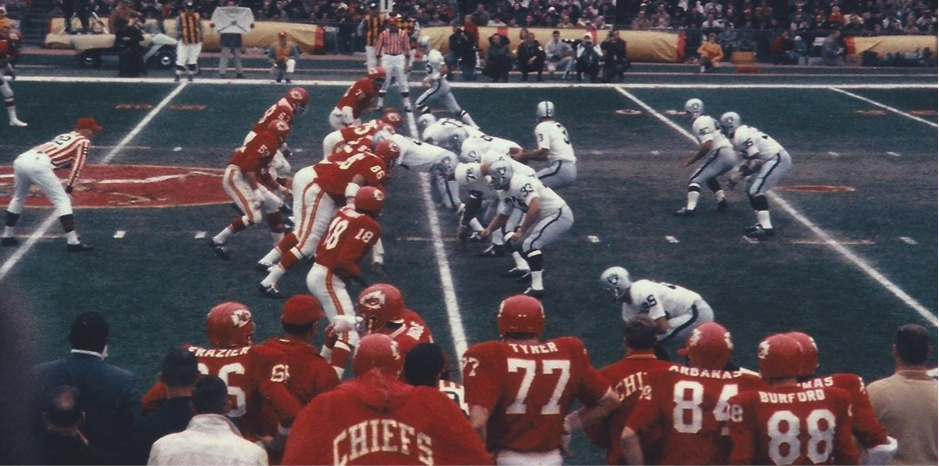 ‘The Mad Bomber’ Lamonica takes the snap and drops back on a day he would never forget.
The game itself truly turned out to be a game of two halves. Kansas City took the opening kick-off and moved well for two series of downs. Then Dawson broke with his earlier conservative image and sent Taylor on a deep fly under the bomb. Oakland’s “soul patrol” – the four high-flying defensive backs – were not to be bombed out just yet, though. Cornerback Willie Brown managed to get a hand between Taylor and the perfectly thrown pass, and suddenly the Chiefs seemed to go limp.
The first half was all Oakland – almost. Lamonica hit Warren Wells for 24 yards to the Kansas City three. Charlie Smith hopped in for the touchdown on the next play untouched, and Oakland were halfway to the 14-point lead Lamonica thought he would need to win. When the Raiders went ahead, Willie Lanier found himself with tears in his eyes. “They’re not going to score again,” he raged. The Chiefs began to toughen. All during the season, with Dawson out for a spell and later fragile, the Chiefs had had to learn determination. “Our defense was aged in disaster,” Stram said afterwards.
With fewer than three minutes remaining in the half and fans beginning to yawn over what was an obvious mismatch, even if the score was only 7-0, Dawson began to drive the ball. Throwing under intense pressure from the Raiders’ front four, and with Oakland’s linebackers gobbling up his running backs, Dawson unwrapped one of Stram’s new sets. It broke Pitts clear for a pretty 41-yard pass reception down to the one-yard line, and Wendell Hayes ran in for the score.
It was the only penetration of Oakland’s turf in the whole first half, and it permitted the Chiefs to go into the locker room with a tied score at half-time.
During the intermission, Stram was inspirational:
“I dwelled on the championship,” he said later. “‘Turn it on,’ I told them. ‘Give it all you’ve got. It’s in our grasp, now squeeze it.’”
If the first half had been Oakland’s, the second was even more impressively Kansas City’s. It turned on the immense strength of the Chiefs’ pass-rushers: Mays and Brown. Madden had foreseen the results. Almost prophetically, on the day before the game, he said: “It’s going to be a match of great strengths, a very physical game. If Kansas City is stronger, we’ll lose.”
Finesse was forgotten as Mays and Brown blew through Oakland’s offensive line. Lamonica was sacked repeatedly. On one of those sacks – the second time Oakland had the ball in the second half after a Mike Garrett fumble at the Chiefs’ 33 put the Raiders in scoring position – the whole game came unstuck. Brown blasted through and bore down on Lamonica just as he was releasing the ball.
“As I clocked Daryle, he hit me with the follow-through,” Brown said later, “right in the face mask.” The jolt strained a tendon in Lamonica’s passing hand and jammed his thumb and first two fingers. In came 42-year-old George Blanda and thereafter chaos reigned. After a Blanda pick, the Chiefs rumbled downfield and scored the go-ahead touchdown. Lamonica then returned to the game, sore-handed but flinging the ball anyway, and the fun began. Ultimately, three of his passes were intercepted by the Chiefs. Not to be outdone, the Chiefs offense delivered three fumbles to the Raiders, each of them representing a scoring chance. It was ludicrous. The Chiefs would manage to add a field goal as insurance and the now-panicked Raiders offense could not reply. The Chiefs defense finished off one of the great upsets in league history.
Lamonica cut the saddest figure of all. Proud almost to the point of arrogance, he now stood dejected, in pain and defeated. Yet he stayed in the locker room until the last reporter had asked the last question before packing up and heading for the hospital.
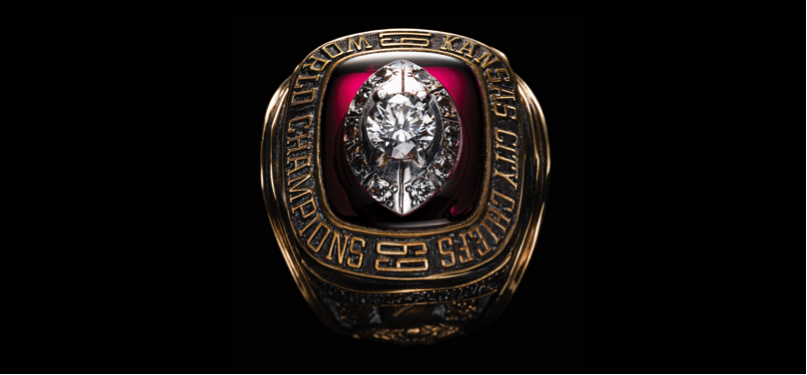 In the Chiefs’ quarters, the big cry was: “The ring! The ring! We’ve got the ring!”
Kansas City would advance to the Super Bowl and defeat the NFL’s Minnesota Vikings to even the count at 2-2 between the AFL and NFL. In the process they effectively became the first ‘Wild-Card’ team to win the Super Bowl, although the term wild card would not be used in the NFL for a few years yet.
Dawson says he thinks both the Jets and the Raiders could have beaten the Vikings, which goes to show just how much the last-ever AFL Championship game mattered.
By Robin Held
Robin Held is the editor of The Neutral Zone. He can be contacted at: editor@theneutralzone.co.uk