


Chris Borland – Walking Away
Is Chris Borland’s decision to retire after just one professional season and end his time at the San Francisco 49ers a sign of things to come? Is the NFL about to embrace a period of enlightenment when it comes to head trauma? The Neutral Zone investigates.
With the draft looming and free agency in full flow, anticipation for the 2015 NFL season – although still six months away – is starting to grow. That is, unless you’re a San Francisco 49ers fan. After losing superstar linebacker Patrick Willis to retirement earlier this month, the team were shocked to learn just a week later that another prized member of their defense was ready to hang up his cleats. But not, as might have been expected, Justin Smith, who has yet to decide whether or not to put his 35-year-old body on the line for one more season, or even NaVorro Bowman, although a full recovery from the horrific knee injury he sustained in the 2013-14 NFC title game is far from assured.
 Risk or reward?
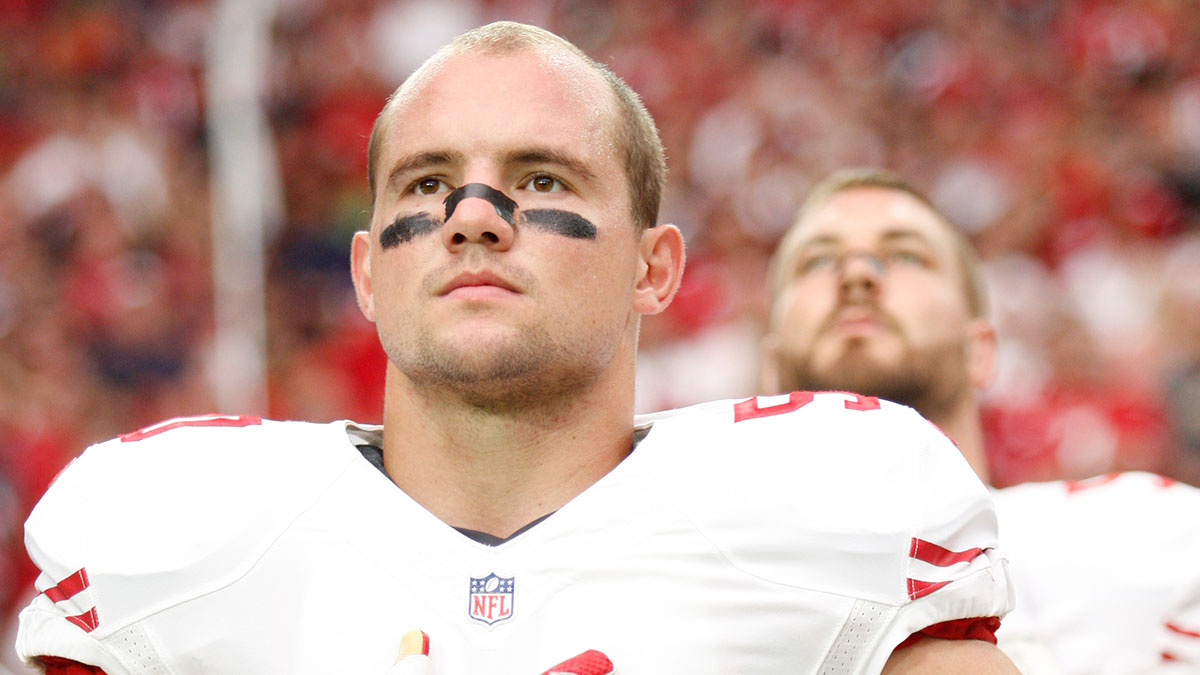
The unwelcome news came most unexpectedly from Chris Borland, an ultra-talented linebacker just coming off his rookie season. And his reason for calling time on a career that had only just begun? Fears over the long-term effects of concussions from the game.
“I just honestly want to do what’s best for my health,” Borland said. “From what I’ve researched and what I’ve experienced, I don’t think it’s worth the risk.”
He admits to having his eyes opened by reading the book League Of Denial while sidelined through injury last season, but insists this wasn’t a spur-of-the-moment thing. The 24-year-old had talked at length with family, doctors and team-mates before informing the team of his intentions. This, he said, was not a football decision, but a matter of self-preservation.
A third-round draft pick, Borland had a four-year contract with the 49ers worth in the region of $3 million, which included a signing bonus of more than $600,000. It has yet to be decided how much he will now have to pay back to the team. The Ohio native, who earned a bachelor’s degree in history at the University of Wisconsin, says he plans to return to school and possibly pursue a career in sports management. He becomes the fourth high-profile NFL player aged 30 or under to retire this off-season. Never has the informal acronym for the NFL – Not For Long – been more apposite.
 Chris Borland impressed at the combine
While Willis, who was placed on injured reserve in November, had suffered plenty of wear and tear during his glittering career, the retirements of 27-year-old Pittsburgh Steelers linebacker Jason Worilds and 26-year-old Tennessee Titans quarterback Jake Locker ahead of potentially lucrative new deals during free agency were bolts from the blue. Although neither player cited safety concerns as a reason for quitting the game, their motives will no doubt come under scrutiny in light of recent events.
But it was Borland’s announcement that raised the most eyebrows and continues to reverberate around league circles. That a player who stood to become an NFL star and make millions of dollars in the process could give it all up so readily has to be regarded as a damning indictment of the game today. The NFL could have a serious problem on its hands in the next three to five years.
The turnover of talent is inescapable given the quality of rookies emerging every year from the draft, the cut-throat nature of the league and the physical punishment endured by players on each and every down. However, recent concussion research is having a profound effect on young men who play in the more ferocious positions such as linebacker, where the sheer force and power of big hits are delivered in the pursuit of opposition offenses.
Borland referred to former NFL greats who were diagnosed with the devastating brain disease CTE after their deaths. Dave Duerson and Ray Easterling chose to end their own lives. And then there was the profound effect that Junior Seau’s suicide had on the NFL community. Here was a man who had enjoyed a long and successful career in the league – one that so many children watching him dreamed of emulating.
Legendary linebacker Junior Seau took his own life
Tragedies such as these can’t fail to have an impact on the next generation of players and, as more information about the damaging effects of football emerge, others could end up drawing the same conclusion as Borland: that it is better to pass on a fortune than put their life at risk. So much for the idea that the proposed multimillion-dollar settlement between the NFL and retired players over concussions would draw a line under the issue.
Borland should be applauded for having the courage of convictions, but the stable and secure home life to which he returns (his father owns The Borland Group, a financial firm) is a not a luxury afforded to everyone in the league. No player should be penalised for their dependency on the game to support their family. In short, the responsibility of player safety rests with the league, not its employees. Of course, morality rarely spurs action. But money does.
The NFL is at the height of its popularity, and reaping the financial rewards – but it can’t rely on the conveyor belt churning out players indefinitely. Borland’s actions will almost certainly, if only in a small way, impact the sport. Parents’ reluctance to let their children play football could turn to defiance, with basketball, baseball and soccer promoted as acceptable alternatives. Falling participation rates would have a knock-on effect on the college game. College football presents a unique opportunity for talented athletes to gain a university education, regardless of their background. It is also big business. The money that college football rakes in pays for nearly every other athletic discipline in the NCAA. If college football struggles, every athletic department struggles. And, in the professional game, with gargantuan sums of guaranteed money in the bank, players could start calling it a day much earlier.
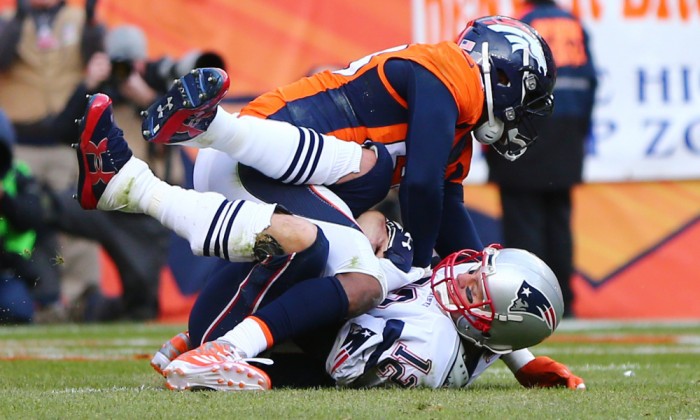
The NFL has begun to take the issue seriously in recent years, reconfiguring the rulebook and rolling out educational initiatives. But to silence those who claim it is doing little more than paying lip service to player safety, the league must present more compelling evidence on the gridiron in the biggest games at crucial times. Do you really mean to tell me that Julian Edelman did not finish the Super Bowl concussed?
 Edelman’s controversial Super Bowl concussion
Another way for the NFL to show that it means business is to hit its franchisees in the pocket. How? Levy financial punishments at teams who do not allow independent doctors to do these assessments.There will be resistance, of course. Fans want the game to remain physical, in keeping with its no-holds-barred past. Human nature being what it is: we like seeing bone-crunching tackles and reserve our loudest cheers for when our team’s players flatten their opponents.
The clubs, meanwhile, will doubtless rail against their star players being hoisted out of the game for precautionary measures. And then there are the all-important TV networks to keep on side. But the NFL has no choice but to fulfil its obligations to the players who represent the shield – even if that means pissing off some key stakeholders in the process. As for Borland, he will have his detractors, and be accused by some of cashing in during his rookie year, despite suffering multiple concussions in college. San Francisco fans might even consider his actions cowardly, abandoning the team that drafted and showed faith in him.
 The back of Chris Borland in the NFL
But, for the sensible majority, his bravery – not on the field, but away from it – will be commended. Despite an outstanding rookie year, his legacy will not be one of hard hits, crucial tackles and glory on the field. But it could be even more meaningful. Over to you, Commissioner Goodell.
By Jamie Garwood (@JamieGarwood)