


Paul Brown and Bill Belichick: The Professors of Football
Every so often in sports, a coach comes along who redefines the game. Nowhere is such a figure more revered than in the National Football League. In an environment not conducive to building successful dynasties, a coach who can sustain a team’s success for years is hard to come by.
Take the Browns. Cleveland’s last championship was in 1964 – their only one without legendary coach Paul Brown. From 1945 to 1962, Brown led the team to four AAFC titles, three NFL championships, eight conference titles and five division titles. In his first 12 seasons, Brown took Cleveland to ten championship games. His final record was 115-49-5.
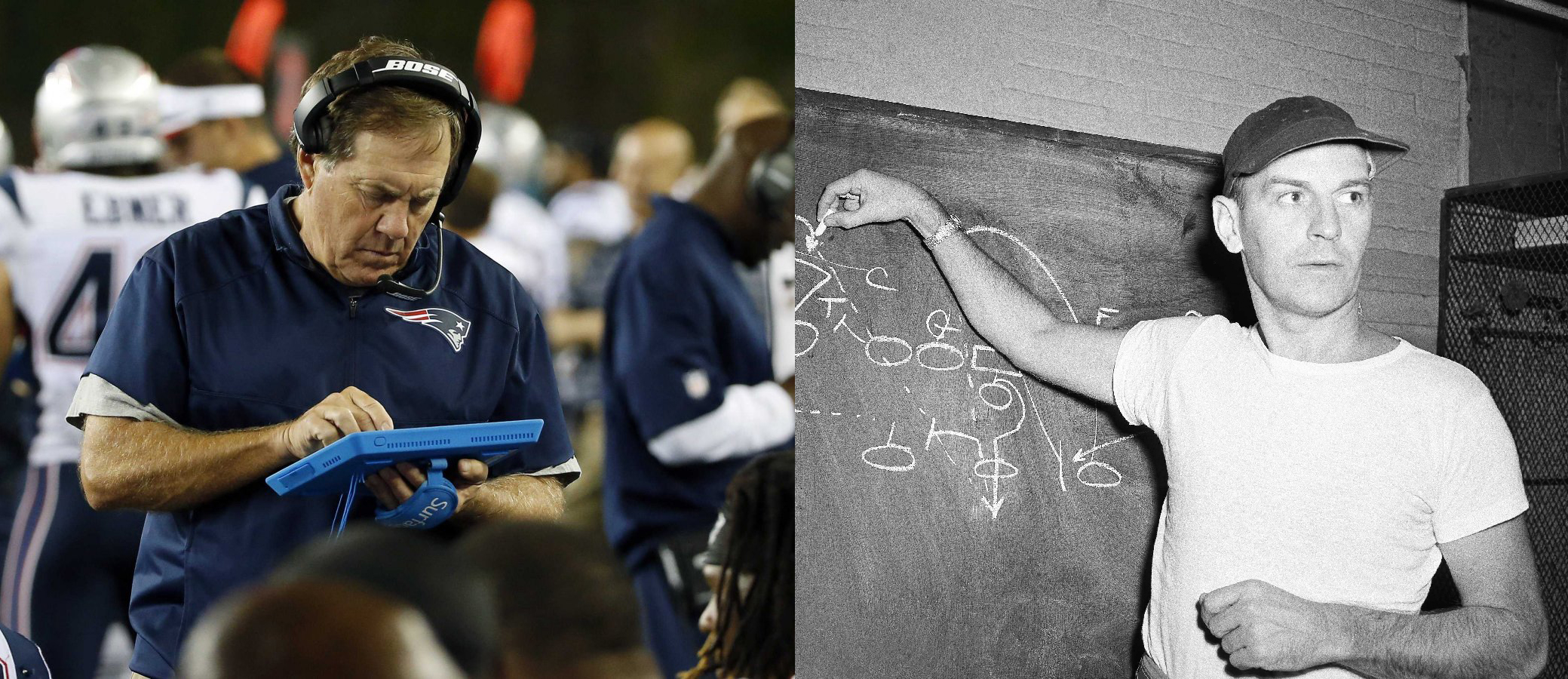
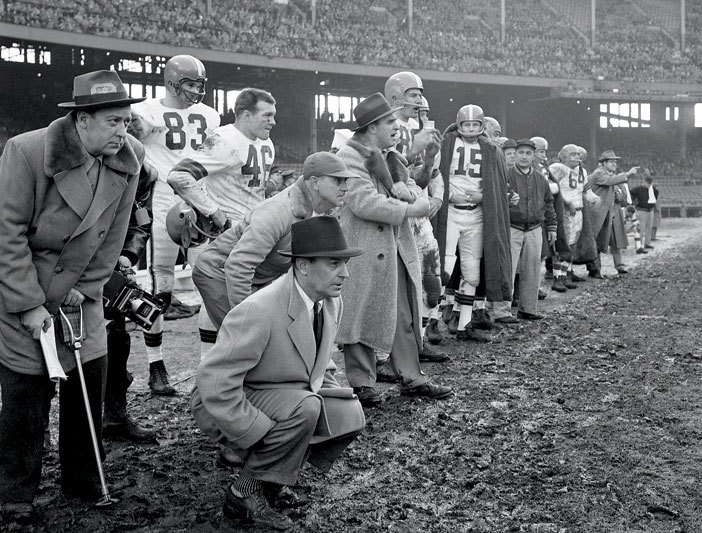 Brown crouches on the sideline during his team’s 1954 NFL Championship win. They beat the Detroit Lions 58-10
Brown rose to prominence coaching at Massillon Washington High School in Ohio, his team boasting an 80-8-2 record over nine seasons. He then moved to Ohio State University, guiding the Buckeyes to the national title with an 18-8-1 record in 1942. After a successful stint coaching at Great Lakes Naval Academy in Michigan during his service in World War II, Brown took the job in Cleveland.
A master tactician and disciplinarian, Brown had a clear picture of what a professional football team should be. His no-nonsense style did not sit well with all of his players, and Brown made no attempt to become their friends. He fired team captain Jim Daniell less than 48 hours before the 1946 AAFC championship game after the player incurred a drunk-and-disorderly charge.
Brown wanted to build the best team in professional football. He approached football as an area of study as well as a sport. Brown coveted disciplined, driven players who would put the team above all else. His approach was unheard of at the time. He held team meetings in a classroom environment, with each and every player expected to copy the plays down into their notebooks and learn them by heart.
For Brown, being the best was all that mattered.
“We’ll settle for nothing less than a winner. When people think of football, I want them to think of the Cleveland Browns.”
Success was hard to come by after Brown. Cleveland needed another coach like their legendary founder. In 1991, they hired a man they hoped would be Brown’s spiritual successor: Bill Belichick. The 38-year-old became Cleveland’s head coach the year Brown died.
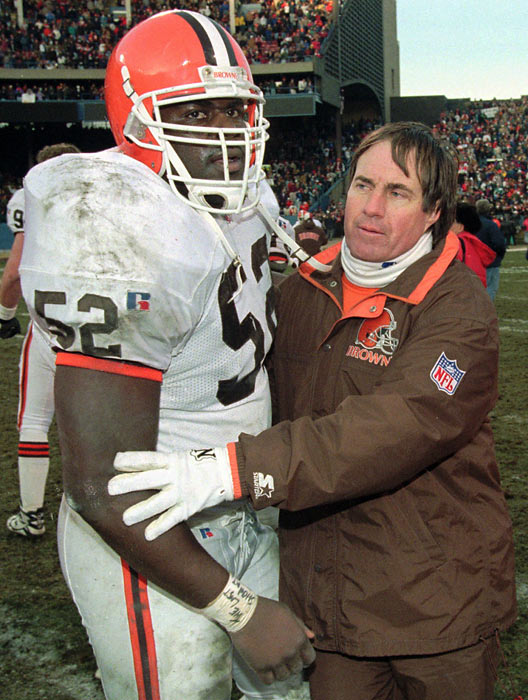 29 years after Brown left, Belichick’s head coaching career began in Cleveland
Belichick had the greatest respect for his predecessor, describing him as “the greatest innovator as a coach that I know of”.
Brown’s influence can plainly be seen in the modern NFL. Classroom sessions are now standard practice. The early West Coast offense that Brown pioneered was revived several times, helping his one-time understudy Bill Walsh take the San Francisco 49ers to three Super Bowls in seven years and becoming the staple scheme for several teams in the modern era. Even Belichick has adopted the fundamentals of Brown’s West Coast offense.
Belichick wanted to build a contender in Cleveland. But his relationship with the players was volatile. A no-nonsense disciplinarian with a short temper, Belichick frequently hurled profanities their way as they attempted to learn his system. Like Brown, Belichick had specific ideas about how a roster should be crafted. But it would take time, and he was under pressure to win fast. After four seasons and a 37-45 record, Belichick was fired.
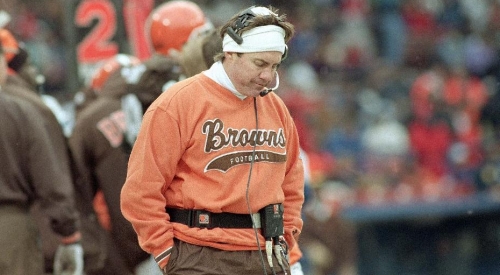 Not so hot in Cleveland
His next shot at the top job would come in 2000 with the New England Patriots. This time, Belichick was determined to make his system work. His philosophy was very similar to Brown’s. The team was the ideal placed above all else, and every player was expected either to work for the good of the team or find another job. This time, Belichick wasn’t the swearing, short-tempered upstart he had been in Cleveland. This time, he nurtured a collaborative culture, preaching mantras such as “The strength of the wolf is the pack” and “It’s not about collecting talent, it’s about assembling a team”.
Belichick’s ‘big idea’ has kept New England as one of the modern NFL’s powerhouses for 15 years. The Patriots have won four out of their six Super Bowl appearances. They have been to the AFC championship game nine times and won 12 division titles.
Although a student of Brown, Belichick has surpassed him. No head coach has won the Super Bowl more times, nor overseen more play-off victories. But with so many similarities in their approaches to team-building and turning the sport into a science, their legacies will never fade.
As Brown once said:
“We’re getting the guesswork out of football. We’re making a science out of what is called a game.”
By Edd Hodsdon (@NFLUnderCentre)