


Getting to the Quarterback
 In the weeks leading up to the 2015 NFL Draft, The Neutral Zone’s resident college expert, Junaid Hussain, will be taking an in depth look at the key talking points, analyse the most promising players and make some bold predictions. First on his agenda is the most important position in the NFL – the quarterback.
To QB or not to QB? That is the question.
Are you an NFL team picking outside of the top five in this year’s draft and desperately in need of a franchise quarterback? If the answer is yes, then you’re almost certainly out of luck.
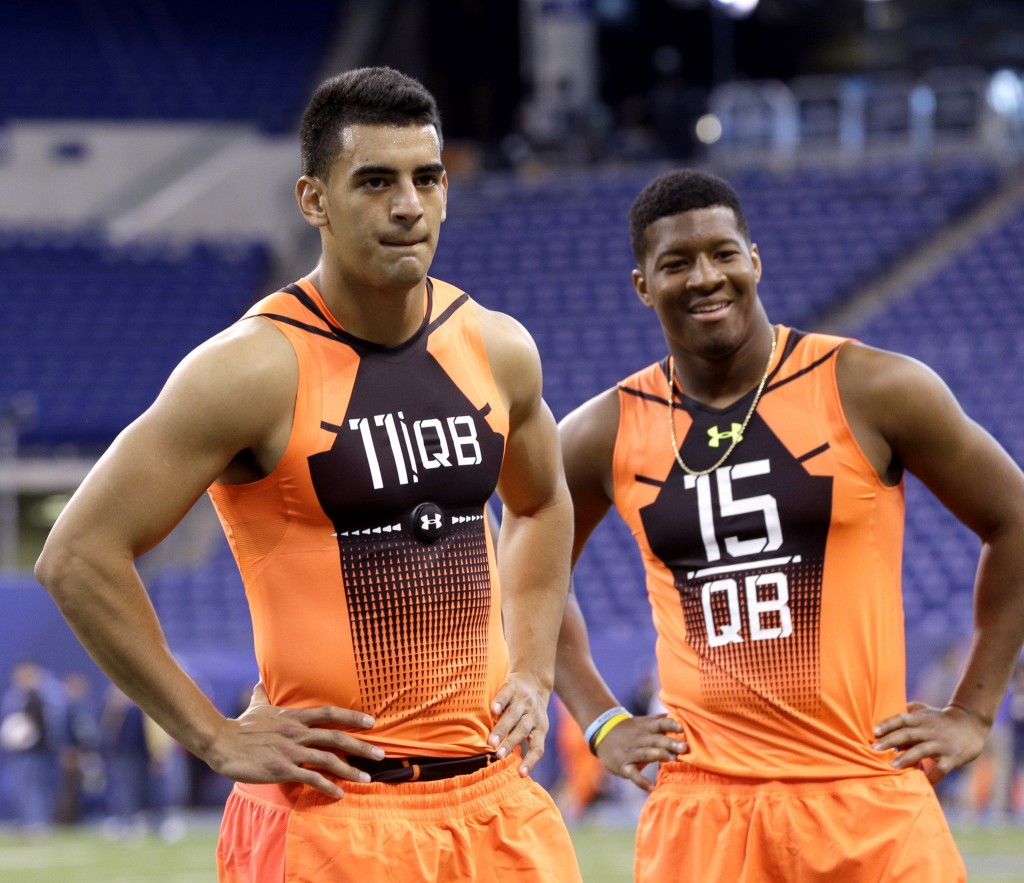 Mariota and Winston combine to make a promising duo
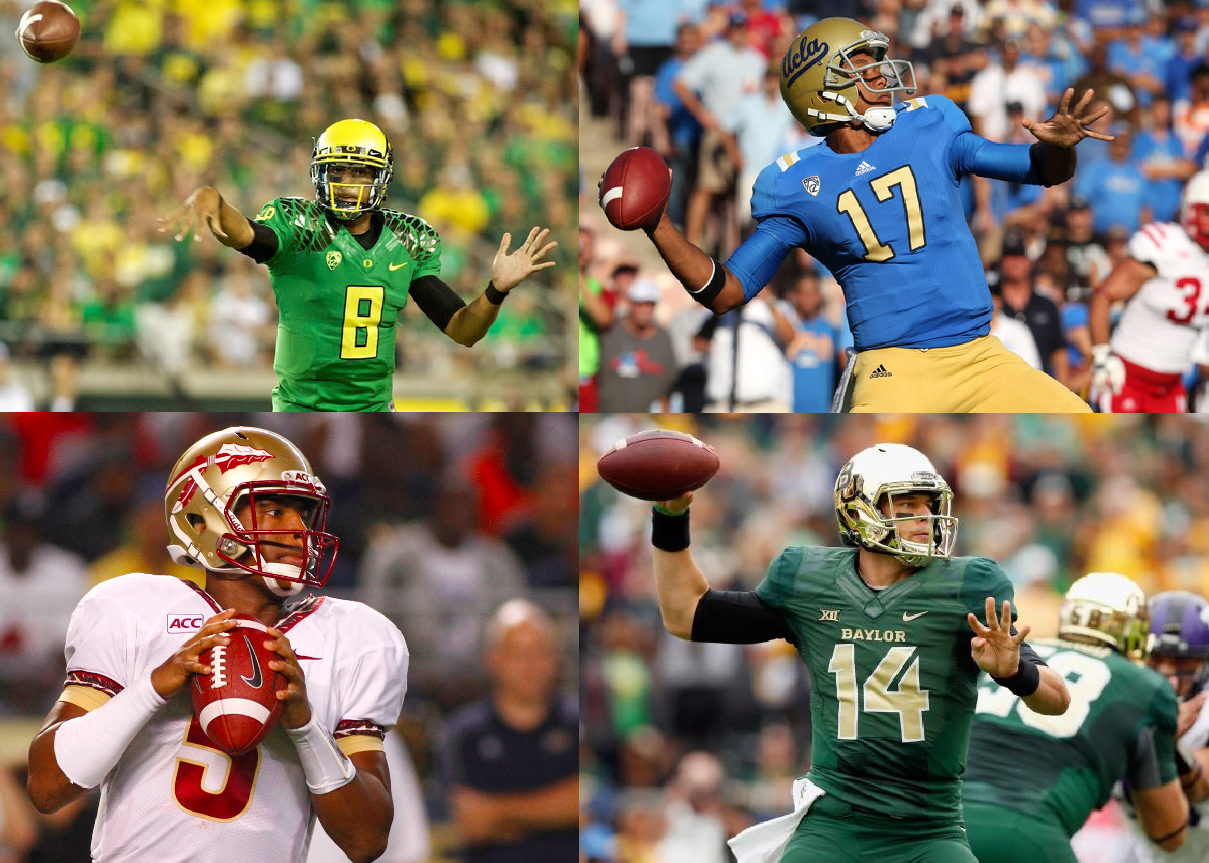
Oregon’s Marcus Mariota and Florida State’s Jameis Winston are the only standout signal-callers in the 2015 class and sure to be among the first few names called by the commissioner in Chicago on 30 April. In years gone by, Mariota and Winston’s very apparent flaws could have caused them to tumble down the draft board but, with so many of today’s NFL teams in dire need of help under center, these young quarterbacks are the talk of the town.
Mariota shows off his devastating speed in the 40-yard dash.
Winston’s history of bad behaviour is reason enough to steer well clear. Stealing crabs’ legs and shouting lewd profanities in the cafeteria make for a worrying college résumé. You need only look at the Cleveland Browns’ Johnny Manziel and Josh Gordon to see why off-the-field issues are a major red flag to most general managers.
Mariota only has experience of playing in the Ducks’ unique, quirky system. Is it realistic to expect him to adapt to a professional offense and be ready as soon as September?
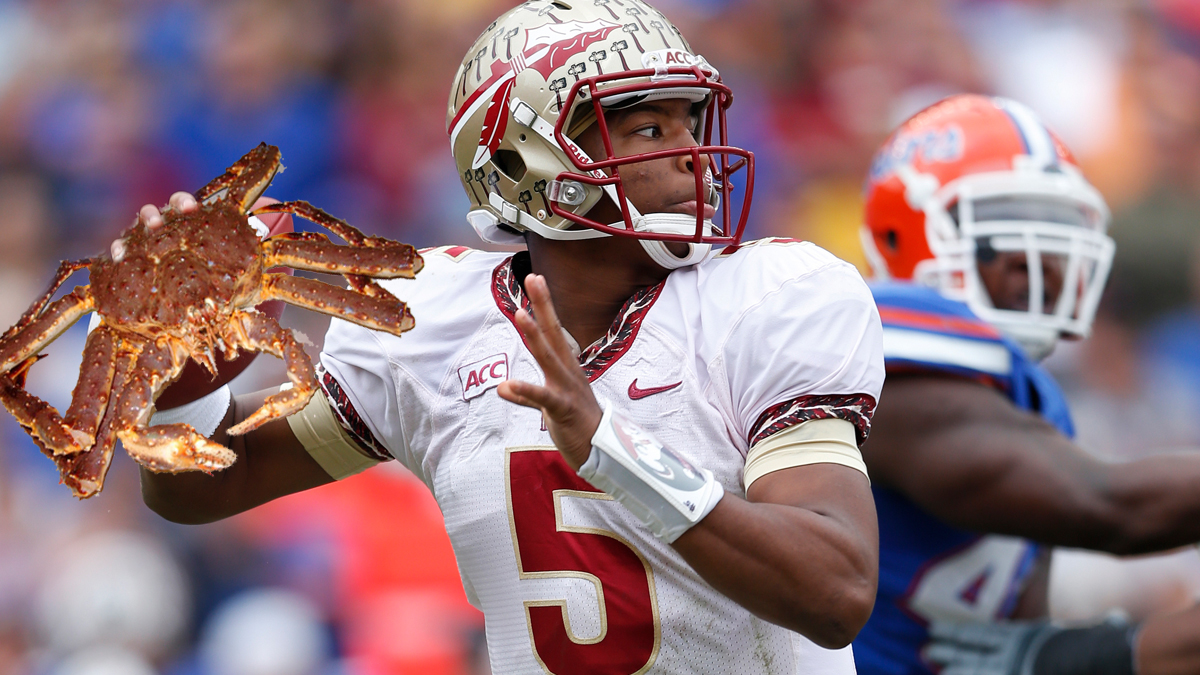 Winston’s misdemeanours could make him one of the draft’s deadliest catches
Despite these obvious and well-documented concerns, the temptation to select Mariota or Winston could be impossible to resist for the Tampa Bay Buccaneers or Tennessee Titans with the first and second overall picks. After all, their current incumbents – Mike Glennon and Zach Mettenberger – aren’t exactly edge-of-the-seat alternatives.
Drafting players is a speculative business – but, in a quarterback-driven league, sometimes passing on one is the biggest risk of all. The equation is simple: without a quality quarterback, you aren’t going to win many games. Just look at the St Louis Rams, who have a top-tier defense, and no shortage of playmakers on offense, but have been held back season after season by their failure to replace the wayward-when-not-injured Sam Bradford. There is only so far a pedestrian quarterback can get you – in the case of the Rams, 7-9.
The Arizona Cardinals signed Carson Palmer two seasons ago and their fortunes almost immediately improved. After going from 5-11 in 2012 to 10-6 in Palmer’s first season, the Cardinals last year found themselves leading their talent rich-division, propelled by an offense putting up impressive numbers. But when Palmer’s knee blew up, so did Arizona’s chances and, despite the best efforts of back-ups Drew Stanton and Ryan Lindley, a deep play-off run proved out of reach. This was potentially a championship team until Palmer went down.
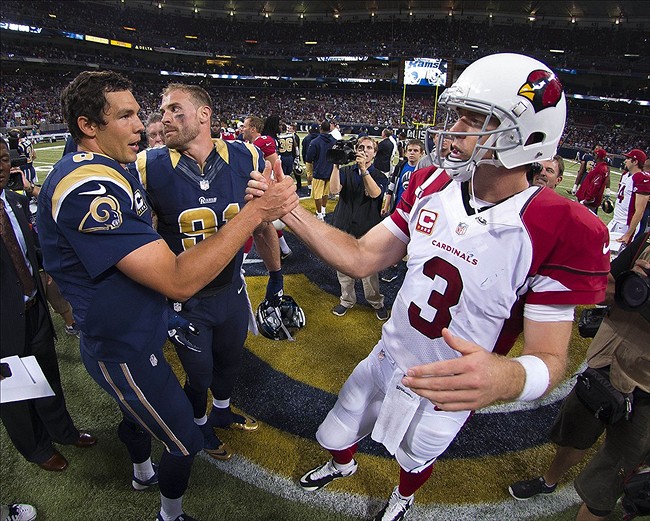 Bradford and Palmer, healthy, on the same field – a rare sighting
A desperation move in free agency this year is not going to significantly upgrade teams with quarterback frailties. You know you are looking at a bum crop when Josh McCown and Mark Sanchez are the best guys available. They might, however, serve some purpose as a bridge quarterback until a promising rookie comes of age.
So who of those beyond the big two are on offer in this year’s draft? Bryce Petty of Baylor has his admirers, as does Colorado State’s Garrett Grayson. But neither is realistically first- or even second-round material. Petty followed in the footsteps of Robert Griffin III, playing in the Bears’ up-tempo offense, and the sceptics fear he might struggle to adapt to the NFL in similar fashion to his predecessor. Grayson is more of an unknown quantity, having played for a mediocre college outfit and sitting out the NFL Combine with a hamstring injury. Nevertheless, he shows the potential to be a pocket passer and has read-option experience to boot – a prospect a team such as the Philadelphia Eagles might keep tabs on.
 Could Garret Grayson be the answer?
Brett Hundley of UCLA is a more pro-ready prospect in many experts’ eyes – he has the size, arm strength, athleticism and dual-threat capability that you look for in a modern NFL quarterback. However, it would still be a huge leap of faith to select the 21-year-old before the middle of the second round. Hundley is inconsistent and, as is becoming the norm in recent years with college quarterbacks, has little experience of an NFL-style offense. He does, however, hold school records for total offense and touchdown passes, and won an impressive 29 games in his three years in Southern California.
Hundley knows how to excite the crowd
Late-round diamonds in the rough – such as the two most recent Super Bowl quarterbacks, Tom Brady and Russell Wilson – are incredibly hard to find in the draft. A sixth-round superstar such as Brady is just as likely to have been selected by sheer luck as astute judgment, and it happens about as frequently as a Cleveland Browns play-off run.
Neither the New England Patriots nor the Seattle Seahawks expected their current starters to come in and succeed like they did. Surrounding them with stellar pieces to help the transition was essential. The Patriots had a sensational Bill Belichick-built defense and was a franchise ready to win. Seattle had a great running back to support Wilson as well as a top-five defense of their own.
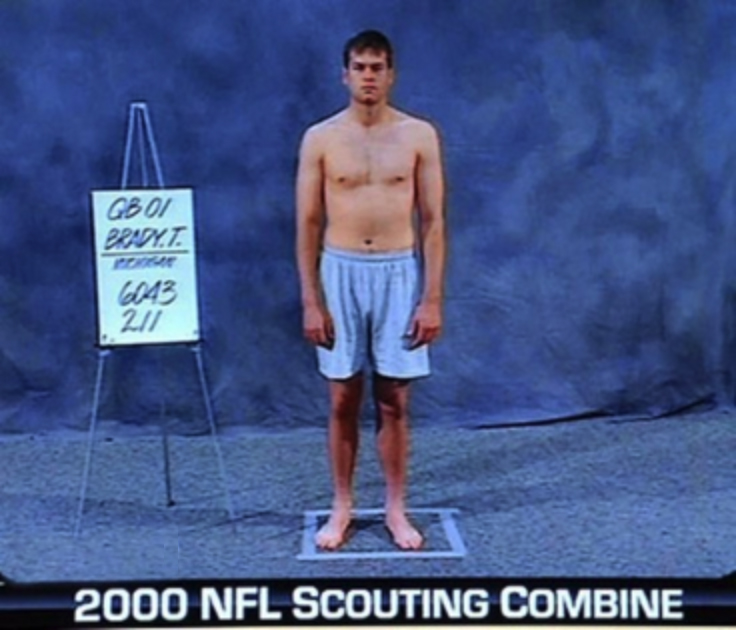 Tom Brady – superstar quarterback
Sometimes a bold, critic-defying selection at quarterback works out – other times, it does not. The Jacksonville Jaguars, for example, traded up for Blaine Gabbert in 2011, banking on him becoming their offensive cornerstone for a decade to come. Unfortunately for the Jaguars, the gamble didn’t pay off and his selection set the team back years.
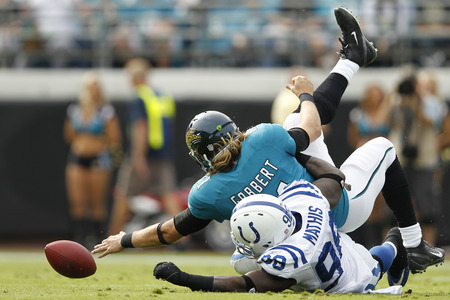 Gabbert doing what he does best
Newly structured rookie contracts enable teams to add roster depth and sign other players while the projected future of your franchise is making minimum moolah – particularly if he slips beyond the first round. The Seahawks used the system to perfection, adding Cliff Avril and Michael Bennett and extending Richard Sherman and Earl Thomas – all while paying Wilson just $3 million for four years of service.
 Wilson might be feeling undervalued
When to draft a quarterback – and which one to bet on – is the most important decision a franchise has to make. All parties – from the scouts all the way up to the owner – must be on the same page. Otherwise, things can go very wrong, very quickly. Just ask the Cleveland Browns.
By Junaid Hussain (@j_hussain)